What is digital marketing? A guide for NZ businesses
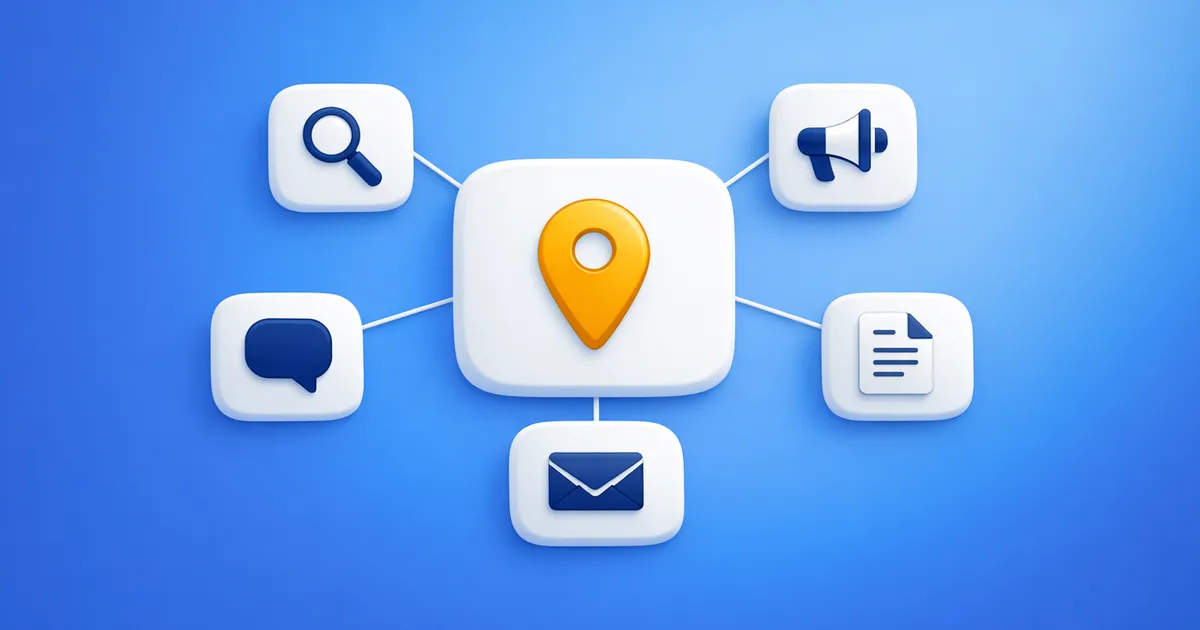
What is digital marketing? Digital marketing is any marketing that reaches people through the internet: search engines, websites, social media, paid ads, email and online reviews. For a New Zealand business it means being found, trusted and chosen by customers at the moment they search, scroll or compare options online, and then measuring what that effort actually returns.
Short answer: digital marketing is promoting your business online, using channels such as SEO, Google Ads, social media advertising, email and content. Unlike a billboard or a letterbox drop, almost every part of it can be tracked, so you can see what brought in enquiries and sales and put more money where it works. First Page NZ is a digital marketing agency headquartered in Auckland, serving businesses from Northland to Southland with a 100% New Zealand-based team.
This guide answers “what is digital marketing” in plain terms, so you can see what counts as digital marketing for your business and what does not, walks through each of the main types of digital marketing, shows how the channels fit together, covers what it costs and gives you a six-step plan for starting. It is written for owners and managers of New Zealand small and medium businesses, not for specialists.
In this guide
- What is digital marketing, in plain terms?
- Types of digital marketing: the main digital marketing channels
- How the digital marketing channels fit together
- What does digital marketing cost in NZ?
- How to start digital marketing: a six-step checklist
- Should you do digital marketing in-house or hire an agency?
- Frequently asked questions about digital marketing
- Next steps
What is digital marketing, in plain terms?
If you strip away the jargon, the answer to “what is digital marketing” comes down to one question: when someone in New Zealand goes online looking for what you sell, will they find you, and will they pick you?
Those people might type “plumber Hamilton” into Google, ask ChatGPT for a recommendation, watch a video on YouTube, see an Instagram ad, or open an email you sent last month. Digital marketing is the work of showing up in each of those places with the right message, and of making it easy for them to get in touch or buy.
What is digital marketing compared with traditional marketing?
Another way to see it is to set it beside the older kind. Traditional marketing covers print, radio, TV, billboards and direct mail. It still works for some businesses, but it is hard to measure. You rarely know which radio spot produced which phone call.
Digital marketing differs in three practical ways:
- It is measurable. Tools such as Google Analytics and Google Search Console show how many people visited, where they came from and what they did next.
- It can be targeted. You can show an ad only to people searching for a specific service, or only to people in Christchurch, rather than paying to reach everyone.
- It can start small. A small business can begin with one channel and a modest monthly budget, then scale up what proves itself.
That does not make traditional marketing obsolete. Many NZ businesses use both, but the online side is usually where the most trackable return sits.
Why digital marketing matters for NZ small businesses
Asking “what is digital marketing” is a good first step, but the more useful question is why it matters. Most buying decisions now begin with a search or a recommendation online. If your competitor appears on page one of Google, has a strong Google Business Profile with reviews and answers questions clearly on their website, and you do not, they get the enquiry first. For a small business with a limited budget, digital marketing is also one of the few ways to compete with larger firms on equal footing: a well-optimised local page can outrank a national brand for a search in your own city. Our guide on how digital marketing helps small business goes deeper on this.
Types of digital marketing: the main digital marketing channels
Once you can answer “what is digital marketing” in your own words, the next question is which parts to use. When people ask about the types of digital marketing, they usually mean the channels you can use to reach customers. Here are the ones that matter most for New Zealand businesses, and when each makes sense.
SEO and AI search (GEO)
SEO comes first for most local businesses. Search engine optimisation (SEO) is the work of making your website show up in unpaid Google results. It covers the content on your pages, technical health such as speed and mobile layout, and the signals that show your site can be trusted, such as links from other reputable sites and genuine reviews.
SEO is slower than advertising, because it can take months to build momentum, but visitors you earn do not cost you a fee per click. Google’s own SEO Starter Guide is a good plain-language reference for the basics.
A newer layer is AI-search optimisation, sometimes called generative engine optimisation (GEO). People increasingly ask ChatGPT, Gemini, Perplexity and Google’s AI features for recommendations instead of scrolling through results. Being clearly described, consistently listed and well reviewed online makes it more likely those tools mention you. First Page NZ covers this under AI SEO, and our AI agency page explains the wider AI services.
For local businesses, SEO also includes your Google Business Profile, which controls how you appear on Google Maps and in the local “map pack”. If you serve customers in a particular suburb or city, this is often the single most valuable thing to get right first. You can read how we approach it on our SEO page.
Google Ads and pay-per-click (PPC)
Google Ads lets you pay to appear at the top of search results, in Google Shopping, on YouTube and across a network of websites. In a pay-per-click model you are charged when someone clicks your ad, not when it is shown. Google explains how the system works in its Google Ads Help Centre.
Ads are fast: a well-built campaign can bring enquiries within days. The trade-off is that traffic stops when the budget stops. Ads also need ongoing management, since poorly targeted keywords can waste spend quickly. For the full picture, see our guide to everything you need to know about Google Ads.
Social media advertising and social media marketing
Social media marketing covers both organic posting and paid advertising on platforms such as Facebook, Instagram, LinkedIn, TikTok, YouTube and Pinterest. Paid social lets you target by location, interests, job title and behaviour, which makes it well suited to building awareness and to retargeting people who have already visited your website.
Which platform suits you depends on who you sell to. LinkedIn is usually stronger for business-to-business services, while Instagram and Facebook often suit retail, hospitality and consumer services. Our comparison of the best social media platforms for advertising your business helps with that choice.
Email marketing and automation
Email is the quiet workhorse for repeat customers. It lets you speak directly to people who already know you: past customers, enquiries and subscribers. Because you own the list, you are not at the mercy of an algorithm change. Email is useful for repeat sales, appointment reminders, newsletters and follow-ups after an enquiry. Automation tools can send the right message at the right time, such as a welcome sequence for new subscribers, without someone writing each one by hand. In New Zealand, the Unsolicited Electronic Messages Act requires consent and an unsubscribe option for commercial email, so build your list with permission.
Content marketing
Content is the part of digital marketing that most owners underestimate. Content marketing means publishing useful material that answers your customers’ questions: guides, how-to articles, videos, case studies and FAQs. Good content supports almost every other channel. It gives SEO something to rank, gives social media something worth sharing, gives email something worth sending and gives AI assistants clear, quotable answers. It works best when it is specific. A page that explains how a Wellington café can fix its Google listing will outperform a vague article about “the power of digital”.
Conversion rate optimisation (CRO)
Conversion rate optimisation is the work of getting more of your existing visitors to take action, whether that is calling, booking or buying. It covers clearer headlines, simpler forms, faster pages, better calls to action and testing one version against another. CRO is easy to overlook, but it multiplies the value of everything else: if you double your conversion rate, you get twice the enquiries from the same traffic.
Reputation and reviews
Reviews on Google, Facebook and industry sites influence both rankings and buying decisions. Most people read them before contacting a business. Asking happy customers for reviews, replying to feedback professionally and keeping your business details consistent online are low-cost habits that support every channel above.
How the digital marketing channels fit together
A common mistake when you first ask “what is digital marketing” is to treat each channel on its own. The channels are not alternatives to choose between. They work as a system, and it helps to think of a customer’s journey in three stages.
| Stage | What the customer is doing | Channels that help |
|---|---|---|
| Awareness | Realising they have a problem or need | Social media, content, SEO, display and video ads |
| Consideration | Comparing options and reading about you | SEO, Google Ads, reviews, email, case studies |
| Decision | Ready to contact or buy | Google Business Profile, search ads, CRO, a clear call to action |
A realistic example: a Tauranga electrician is searched for on Google (SEO and local listing), the customer clicks an ad for “emergency electrician Tauranga” (Google Ads), reads reviews on the Google profile (reputation), lands on a page with a clear phone number and quote form (CRO) and later receives a maintenance reminder by email. Each channel does one job, and together they move a stranger to a booked job and then a repeat customer.
A digital marketing strategy is simply the plan that decides which channels to use, in what order, for which audience and with what budget. We cover the planning side in our guide to digital marketing strategy.
What does digital marketing cost in NZ?
After “what is digital marketing”, the next question is nearly always price. There is no single price, because the cost depends on which channels you use, how competitive your industry is and how much work is done in-house. These are the main cost drivers:
- Channel mix. SEO is usually a monthly retainer. Google Ads and social ads involve two costs: the ad spend paid to the platform and the management fee for running the campaigns.
- Competition. Selling insurance or legal services means more competition for each click than selling a niche product, so ads and SEO both cost more.
- Scope. A single-location business with one service needs less work than an ecommerce store with thousands of products.
- Quality of your website. If your site is slow, hard to use or missing key pages, some budget goes into fixing it first.
For a guide to scale, First Page NZ states on its SEO page that “for small businesses, SEO can range from $500 to $2,000 per month”, depending on competition and scope. Treat that as a range, not a quote. Ad spend is separate and is set by you, and any reputable agency will agree it with you before spending starts. Be cautious about anyone who guarantees rankings or fixed results: no one outside Google controls where a page ranks.
How to start digital marketing: a six-step checklist
Knowing the answer to “what is digital marketing” is the easy part; starting is where most owners stall. You do not need to do everything at once. This order works for most NZ small businesses:
- Set a specific goal. “More leads” is vague. “Twenty extra quote requests a month from Waikato” is something you can measure.
- Know your customer. Write down who buys from you, what they search for, what worries them and which questions they ask before they buy.
- Fix your website basics. Make sure it loads quickly on a phone, states clearly what you do and where, and makes it easy to call, book or buy. No channel will perform well if the site loses visitors.
- Pick one or two channels. Start where your customers already are. Many local service businesses begin with their Google Business Profile, local SEO and a small Google Ads campaign. Add more later.
- Set up tracking. Install Google Analytics 4 and Google Search Console, and track the actions that matter: calls, form submissions and purchases. Without this you are guessing.
- Review every month. Look at what brought in real enquiries, stop what did not, and put the budget behind what did. Digital marketing improves through small, steady adjustments.
Should you do digital marketing in-house or hire an agency?
Once you have an answer to “what is digital marketing” for your own business, you can decide who does it. Doing it yourself suits businesses with time to learn and a simple need, such as maintaining a Google Business Profile, sending a newsletter and posting on one social platform. The risk is that digital marketing changes constantly, and wasted ad spend or a neglected website can cost more than a fee.
An agency suits businesses that want specialist skills, faster progress or more channels than one person can manage. A good agency should explain what it will do in plain language, report results you can verify and tell you what it cannot promise. If you are weighing it up, read why hire a digital marketing agency and how to choose a digital marketing agency, which set out questions to ask any provider.
If you would like help, First Page NZ is a Google Premier Partner (top 3% worldwide) and a Meta Business Partner, and works with New Zealand businesses on SEO, AI SEO, Google Ads, social advertising and conversion optimisation. Our digital marketing agency page explains how we work, or you can call 0800 235 001.
Frequently asked questions about digital marketing
What is digital marketing in simple terms?
In answer to “what is digital marketing”, it is promoting a business online so that the right people find it and choose it. It includes SEO, Google Ads, social media, email and content, and its main advantage over traditional marketing is that results can be measured.
What are the main types of digital marketing?
The main types of digital marketing are SEO (including AI-search optimisation), pay-per-click advertising such as Google Ads, social media marketing and advertising, email marketing, content marketing, conversion rate optimisation and reputation management. Most businesses use two or three of these together rather than all of them.
How much does digital marketing cost for a small business in NZ?
It depends on the channels, competition and scope. First Page NZ’s SEO page states that small-business SEO can range from $500 to $2,000 per month. Paid advertising adds an ad budget that you set, plus management. Ask any provider for a written scope before you commit.
How do I start digital marketing for my NZ business?
Set a measurable goal, work out who your customers are, make sure your website works well on mobile, choose one or two channels, set up Google Analytics and Search Console, and review results monthly. Many local businesses begin with their Google Business Profile and local SEO.
What does a digital marketing agency do for a small business in NZ?
An agency plans which channels to use, builds and runs campaigns, improves your website and content, tracks results and reports back. First Page NZ describes its services, and what working with an account manager involves, on its digital marketing agency page.
How long does digital marketing take to work?
Paid ads can generate traffic within days. SEO and content usually take several months to build momentum, and the timing varies with competition and the state of your website. Be wary of anyone promising an exact date for results.
Next steps
You now have a clear answer to “what is digital marketing” and how it works, so the most useful next move is to pick your first goal and your first channel. If you want a second opinion on where to begin, talk to the team at First Page NZ on 0800 235 001 or at hello@firstpage.nz.